Checklist
Home Safety Assessment Checklist
A room-by-room guide to identifying and addressing safety risks — and building a home environment designed for stability.
Why a Home Safety Assessment Matters
A home that once felt safe can quietly become hazardous as mobility, balance, cognition, or strength change.
Many families only think about safety after:
- A fall
- A medication error
- A kitchen accident
- A wandering episode
- A near-miss
But safety is not reactive.
It should be assessed proactively.
At Coastal Care Partners, home safety is not a one-time walkthrough. It is an ongoing evaluation that evolves with your loved one's needs.
Entryways & Exterior
First impressions matter — and so does stability at the front door.
- ✔Clear pathways free of clutter
- ✔Secure handrails on steps
- ✔Non-slip surfaces
- ✔Adequate outdoor lighting
- ✔Door thresholds that are easy to navigate
- ✔Visible house numbers for emergency access
How We Help:
Caregivers observe how clients enter and exit daily. Nurse Care Managers assess mobility patterns and recommend modifications early.
Living Areas
The living room is one of the most common fall locations.
- ✔Remove loose rugs or secure them
- ✔Eliminate electrical cords across walkways
- ✔Anchor unstable furniture
- ✔Improve lighting to reduce shadows
- ✔Ensure frequently used items are within easy reach
- ✔Reduce clutter to support navigation
For individuals with cognitive decline:
- ✔Avoid busy patterns that may cause visual confusion
- ✔Maintain consistent furniture placement
Coastal Care Partners Difference:
Our caregivers document near-misses and hesitation patterns. Small changes in movement often signal larger risk.
Kitchen
The kitchen presents both physical and cognitive risks.
- ✔Store sharp objects securely
- ✔Install stove knob covers if needed
- ✔Ensure fire extinguishers are accessible
- ✔Keep pathways clear
- ✔Improve lighting over counters
- ✔Label cabinets for cognitive support
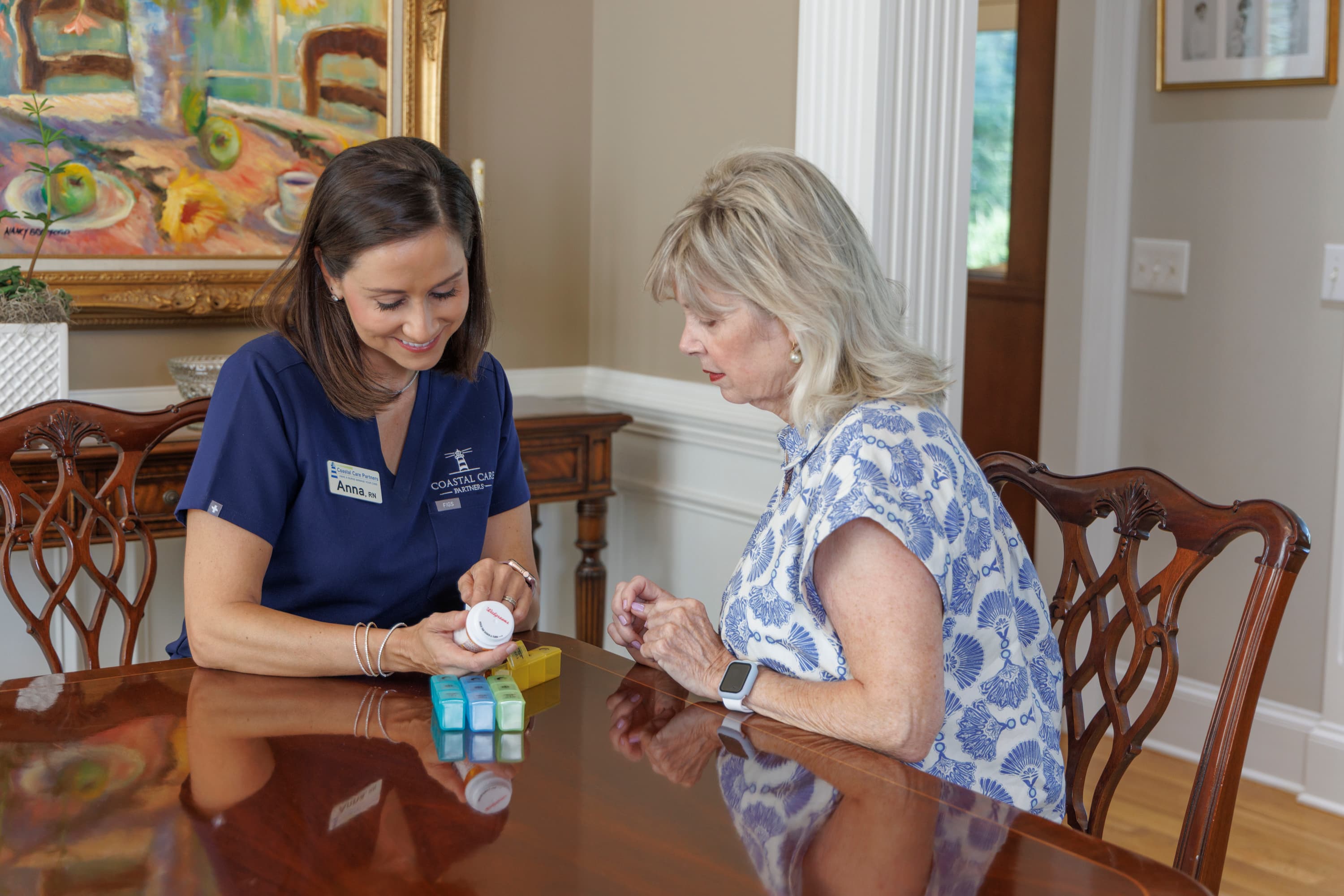
Medication management often happens in the kitchen.
- ✔Organize pill boxes clearly
- ✔Remove expired medications
- ✔Confirm medication timing and understanding
Our Nurse Care Managers reconcile medication changes and monitor adherence patterns after hospitalizations or provider visits.
Bathroom
Bathrooms are high-risk environments.
- ✔Install grab bars near toilet and shower
- ✔Use non-slip mats
- ✔Add shower chair when balance declines
- ✔Consider raised toilet seat
- ✔Improve lighting
- ✔Monitor water temperature
For dementia patients:
- ✔Remove excess products
- ✔Keep items consistently placed
- ✔Use simplified layouts
Our integrated model combines mobility assessment with environmental safety planning.
Bedroom
The bedroom should promote calm and safe movement.
- ✔Clear pathways to bathroom
- ✔Use nightlights
- ✔Remove loose rugs
- ✔Keep assistive devices within reach
- ✔Ensure bed height supports safe transfers
Monitor sleep disturbances and nighttime wandering risks.
Caregivers report patterns. Nurse Care Managers evaluate changes over time.
Stairs & Hallways
- ✔Secure handrails on both sides
- ✔Improve overhead lighting
- ✔Remove decorative items from steps
- ✔Add contrasting tape if depth perception declines
Fire & Emergency Preparedness
- ✔Test smoke detectors
- ✔Install carbon monoxide detectors
- ✔Post emergency contact information visibly
- ✔Ensure clear exit paths
- ✔Confirm accessible phone or alert device
Our team ensures emergency plans are understood by both client and family.
Technology & Monitoring
- ✔Medical alert systems
- ✔Motion sensors if wandering is a concern
- ✔Medication reminders
- ✔Remote monitoring if appropriate
We guide families in selecting tools that support independence without creating unnecessary complexity.
The Risks Families Often Miss
Most hazards are visible.
But the most serious risks often are not:
- Gradual weakness
- Balance hesitation
- Medication side effects
- Confusion at night
- Fatigue
- Dehydration
- Pattern changes over time
Environmental safety is only one part of the equation.
Without observation and coordination, hazards return.
The Coastal Care Partners Approach
Many agencies offer a "home safety checklist."
We provide structured oversight.
- ✔Caregivers observe daily movement patterns
- ✔Nurse Care Managers assess risk trends
- ✔Medication changes are reviewed
- ✔Adjustments are made proactively
- ✔Families are guided through modifications
When a home safety risk is identified, we do not simply note it.
We integrate it into the care plan.
Safety evolves as the individual evolves.
When to Request a Safety Assessment
Consider structured support when:
- A fall or near-fall occurs
- Mobility declines
- Medication changes increase dizziness
- Dementia symptoms progress
- A recent hospitalization occurred
- Family feels uncertain about safety
Early assessment reduces crisis.
Waiting often increases risk.
Final Thought
A safe home is not just free of clutter.
It is supported by structure.
With Coastal Care Partners, safety is monitored, documented, and adjusted — not assumed.
That is how stability is built.